
How to Keep a Car Maintenance Log: A Simple Guide to Tracking Service and Mileage
A car maintenance log is a simple record of every service, repair and part your car gets, with the date, mileage and cost. It takes a minute to update, yet it helps you stay on schedule, avoid paying twice for the same job and show buyers that the car was cared for. This guide explains what to write down, a general maintenance schedule to plan around, how to keep a mileage log for work or taxes and how to choose between paper, a spreadsheet and an app.
Why Keep a Car Maintenance Log
- Stay on schedule: you see at a glance when the next oil change or tire rotation is due.
- Avoid duplicate work: no more paying for a new air filter you replaced two months ago.
- Spot problems early: the same repair showing up again and again is a sign something bigger is wrong.
- Support warranty claims: dated records show the car was serviced as the manufacturer asked.
- Raise resale value: buyers trust a car with a complete service history.
- Know your real costs: totals help you budget for upkeep and decide when repairs no longer make sense.
What to Include in a Car Maintenance Log
Start with a short vehicle profile at the top: make, model, year, VIN, license plate, tire size and the oil type your owner’s manual recommends. Then add one line for every visit or job.
| Column | What to write | Why it helps |
|---|---|---|
| Date | Day of the service | Shows time-based intervals, such as yearly checks |
| Mileage | Odometer reading | Many service intervals are based on miles |
| Service or repair | What was done, in plain words | Avoids repeat work |
| Parts | Part names or numbers, brand of oil or tires | Makes reordering easy |
| Shop or DIY | Where it was done, or by you | Useful for warranty and follow-up |
| Cost | Parts and labor | Tracks total upkeep spending |
| Next due | Date or mileage for the next service | Turns the log into a reminder |
Keep the receipts too. A log line plus a receipt is the strongest proof of service when you sell the car or make a warranty claim.

A General Car Maintenance Schedule
Every car is different, so your owner’s manual always comes first. The ranges below are common general guidelines that help you set up the “next due” column. Harsh conditions, such as short trips, towing, dusty roads or extreme heat and cold, often mean more frequent service.
| Item | Common interval | What to log |
|---|---|---|
| Oil and filter change | About 3,000 to 5,000 miles for conventional oil, 5,000 to 10,000 for synthetic | Date, mileage, oil type |
| Tire rotation | About every 5,000 to 8,000 miles | Date, mileage, tire pressure |
| Engine and cabin air filters | About 5,000 to 15,000 miles, depending on condition | Which filter, date, mileage |
| Wiper blades | Often around every 10,000 miles or when they streak | Date replaced |
| Brake inspection | At regular service visits; pads often last around 50,000 miles | Pad and rotor condition |
| Battery | Often 4 to 5 years | Install date, test results |
| Major milestone services | Around 30,000, 60,000 and 100,000 miles | Full list of work done |
How to Set Up Your Log Step by Step
- 1. Pick a format: a printable sheet, a spreadsheet or a planner section (compared below).
- 2. Fill in the vehicle profile: make, model, year, VIN and recommended fluids.
- 3. Gather past records: add old receipts and dealer printouts, oldest first.
- 4. Write the next due dates: use your owner’s manual to fill in when each service comes up next.
- 5. Make updating a habit: log every job on the same day, before the receipt gets lost.
- 6. Review twice a year: spring and fall are good times to check what is coming up and add seasonal tasks like tire swaps.
How to Keep a Mileage Log for Work or Taxes
A mileage log is different from a maintenance log: it records trips rather than repairs. If you drive for work, for a side business or for rideshare, a clear mileage log helps with reimbursement and tax records. For each business trip, people usually write the date, the starting and ending odometer readings or total miles, the destination and the business purpose. Fill it in at the time of the trip rather than weeks later, and keep it separate from personal driving.
Tax rules differ by country and change over time, so check what your tax authority asks for, or ask an accountant, before relying on a log for deductions.
Paper, Spreadsheet or App?
| Format | Good for | Keep in mind |
|---|---|---|
| Printable log | Glove box records, people who like writing by hand | Needs a folder; no automatic totals |
| Spreadsheet | Totals, averages and several cars | Needs a phone or computer to update |
| Planner section | Keeping car tasks with home and money plans | Less space for long repair notes |
| App | Reminders and photos of receipts | Records live in one service; export a backup |
Many drivers combine two: a spreadsheet for totals and a printed sheet in the car for quick notes.
Car Maintenance Log Templates to Get Started
If you would rather not build your own, these ready-made templates cover the essentials.
Best Car Maintenance Spreadsheet
1. Car Maintenance Log Template
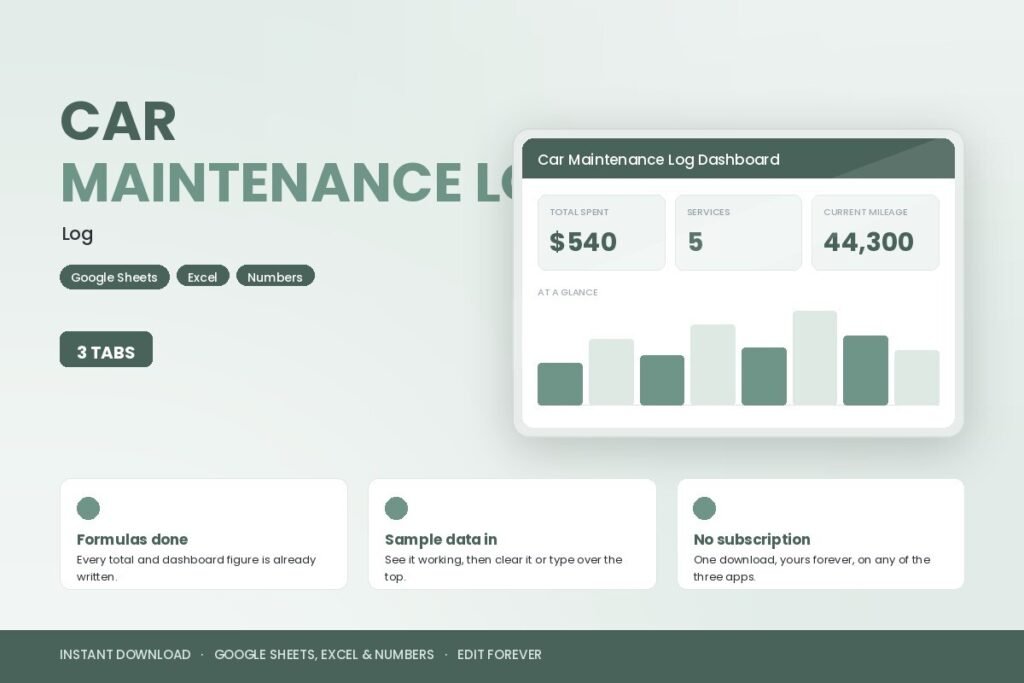
Works with: Google Sheets, Excel, Apple Numbers
Tabs: 3: Start Here, Log, Dashboard
Best for: drivers who want totals calculated for them
- Service log with formulas already written
- Dashboard: total spent, number of services, current mileage, average cost per service
- Sample data to clear or type over
- Start Here tab that explains every column
Type each service once and the dashboard updates on its own, so you always know how much the car has cost to maintain. Open it on a phone at the shop or on a laptop at home.
Best Printable Maintenance Log
2. Vehicle Maintenance Log, Printable

Format: PDF + JPEG
Size: US Letter, A4 and A5
Best for: a simple paper log kept in the glove box
- Make, model and year at the top
- Columns for date, description, mileage and cost
- Ink-friendly design
A clean one-page form covers the four key details. Print a fresh sheet whenever one fills up and keep them in a folder with your receipts.
Best Mileage Log Insert
3. Mileage Log Printable Planner Insert

Pages: 1
Format: PDF
Size: A4 and US Letter
Best for: recording business trips and driving distances
- Trip-by-trip mileage table
- Undated, so you can print it any time
- Minimal design for any planner
Keep a sheet in the car and fill it in at the end of each trip. Clean records make it easier to claim reimbursement or prepare taxes.
Best Oil Change Log
4. Oil Change Log, Printable

Format: PDF + JPEG
Size: US Letter, A4 and A5
Best for: tracking oil changes, whether you do them yourself or at a shop
- Date, description and mileage columns
- Three sizes for binders and planners
- Print a new page whenever needed
One page just for oil changes makes it easy to see when the next one is due.
FAQ
How do I keep track of car maintenance?
Write down every service with the date, mileage, what was done and the cost, and keep the receipts. Add the next due date or mileage so the log also works as a reminder.
What should be in a vehicle maintenance log?
A vehicle profile (make, model, year, VIN) and one line per job with date, mileage, service, parts, where it was done, cost and next due.
Do maintenance records increase resale value?
A full service history usually makes buyers more confident, which can help you sell faster and at a better price.
How often should I check my car’s oil and tire pressure?
Many drivers check both about once a month and before long trips. Your owner’s manual lists the right oil level and tire pressure for your car.
When should I take my car to a mechanic right away?
Get the car checked promptly if a warning light stays on, the brakes feel soft or make grinding noises, the engine overheats, you smell fuel or burning, or the steering pulls strongly. When in doubt, stop driving and ask a qualified mechanic.
Final Thoughts
A car maintenance log takes a minute after each service and pays off for as long as you own the car. Start with the vehicle profile, add past receipts, write the next due dates and keep updating it, on paper or in a spreadsheet. For more background, see this article on car maintenance.