

Hourly Planners: 15 Best Time Blocking Templates for Busy Days
Hourly planners give every task a place on the clock, which makes it much harder for the day to slip away. This list includes complete time blocking systems, a deep work planner, a work set with Excel spreadsheets, daily hourly pages in A4 and A5, weekly hourly spreads and a fillable PDF you can type into. Most are undated, so you can reuse them every day or week.
Quick Picks
- Best complete system: Premium ADHD Time Blocking System
- Best for focus: Deep Work Planner
- Best for work: Productivity & Time Management Templates
- Best all-in-one day page: Hourly Daily Planner Printable PDF
- Best two-page spread: Printable Weekly Hourly Planner Template
Time Blocking Systems
These sets combine time blocks with focus, priority and review tools.
Best Complete System
1. Premium ADHD Time Blocking System
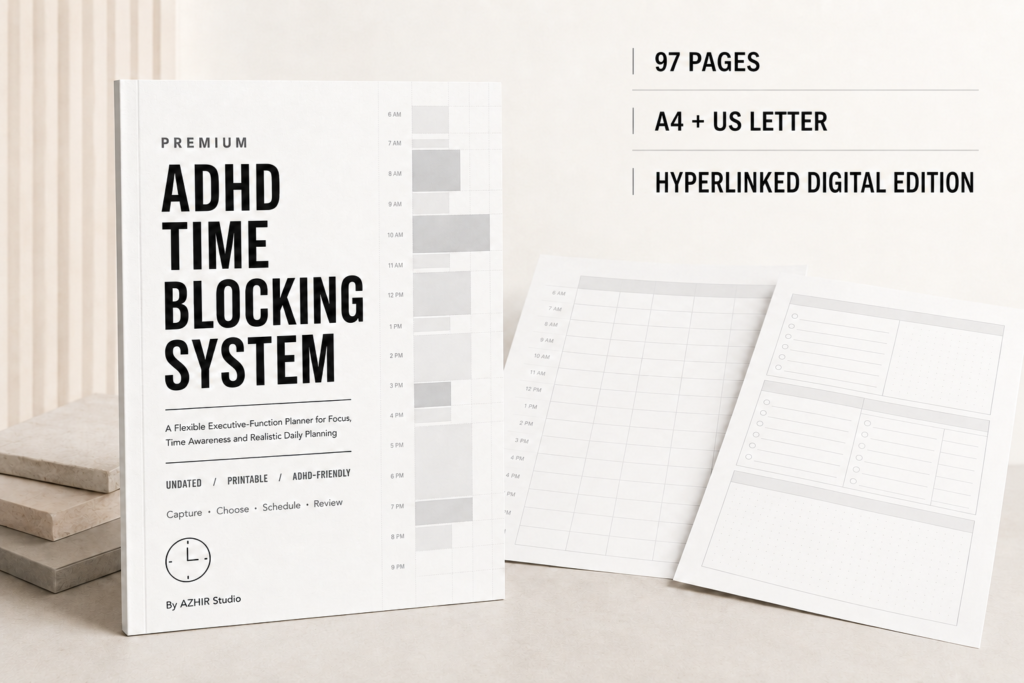
Format: Printable PDF + hyperlinked PDF
Pages: 97
Size: A4 and US Letter
Dates: Undated
Best for: anyone who plans in time blocks but struggles to stick to them
- Hourly and half-hour time blocking pages and a three-block day planner
- Focus-block, deep-work, Pomodoro and body-doubling session planners
- Brain dump, priority filter, task breakdown and buffer and transition-time pages
- Overwhelm reset, energy and focus tracking and weekly, monthly and quarterly reviews
It goes beyond a schedule grid with tools for starting tasks, managing distractions and recovering after a bad day. The grayscale design prints cleanly, and the hyperlinked version works in GoodNotes and Notability.
Best for Focus
2. Deep Work Planner
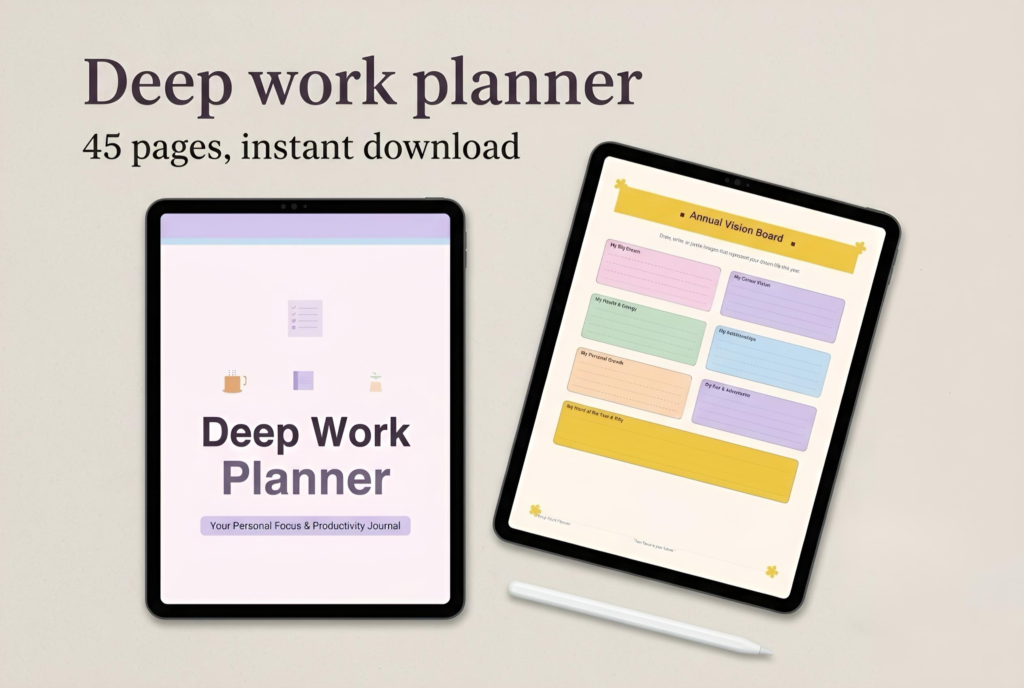
Format: Printable planner
Best for: protecting long stretches of focused work
- Daily deep work pages with time blocks, an energy tracker and end-of-day reflection
- Time blocking guide, weekly planning dashboard and monthly overview
- Distraction audit, digital detox plan and focus score tracker
- Pomodoro tracker, session log and wins tracker
A deep work commitment contract and an ideal environment planner help you set up the conditions for focus. Annual vision and SMART goal pages connect daily time blocks to bigger goals.
Best for Work
3. Productivity & Time Management Templates

Format: Printable PDF + Excel (.xlsx)
Pages: 10
Size: A4 and US Letter
Best for: professionals and freelancers who plan on paper and in spreadsheets
- Time blocking planner, daily productivity planner and weekly schedule planner
- Priority matrix worksheet and task and to-do list tracker
- Meeting notes and action items page and project deadline tracker
- Monthly goals tracker, habit and routine tracker and weekly productivity review
Editable Excel files sit alongside the printable pages, so you can keep task lists on the computer and time blocks on paper. The minimal pastel business style looks tidy on a desk.
Daily Hourly Planners
One page per day, divided by the hour.
Best All-in-One Day Page
4. Hourly Daily Planner Printable PDF

Format: Printable PDF
Size: A4, A5, US Letter, Half Letter
Dates: Undated
Best for: planning the day and tracking wellness on one page
- Full 24-hour schedule with generous time blocks
- Today’s goals, appointments and reminders
- Meal, water, exercise, steps and money in and out trackers
- Gratitude section and a mood and weekly overview
A fresh mint-blue design keeps a busy page calm and readable. Because it is undated, you can print a fresh copy every day.
Best A5 Size
5. A5 Daily Hourly Planner

Format: Printable
Size: A5
Dates: Undated
Best for: small ring planners and binders
- Undated daily hourly layout
- Space for schedule, to-do list, priorities and notes
- Clean, minimalist design
The A5 size fits most ring planners and travel binders. Print a stack and add a page to your planner each morning.
Best Cute Design
6. Cute Daffodil Daily Tracker

Format: PDF, PNG, JPG
Best for: planning the day in a cheerful floral style
- Hourly planner and habit tracker layouts
- Daily goals, notes and gratitude sections
- Water intake tracker and several spring color variations
Cheerful daffodils make daily planning feel lighter. The pages work as printable inserts or in a digital planner.
Best Classic Day Grid
7. Classic Hour-by-Hour Daily Planner –

Format: Canva template + PNG
Hours: 6 AM – 10 PM
Best for: precise daily planning with meetings and appointments
- Day split into hourly blocks
- To-do list
- Notes section
A classic hourly grid suits anyone with a calendar full of meetings and appointments. Customize it in Canva and print as many copies as you need.
Best Balanced Day
8. Daily Planner Printable A4, Minimal

Format: PDF, AI, EPS, JPG
Size: A4
Best for: time blocking with a few healthy habits on the side
- Priority of the day and time blocking
- Hydration, mood and meal trackers
- Notes section
Time blocks and small wellness trackers sit on one calm page. It is ready to print at home or to use in a digital planner.
Best Fillable PDF
9. Time-Blocking Daily Planner

Format: Canva template, PDF, fillable PDF
Best for: typing your time blocks on a phone or tablet
- Daily time-blocking layout
- Fillable PDF for smartphones and tablets
- Ready-to-print PDF and editable Canva template
The fillable PDF lets you type into the page without a stylus. Its simple, modern design works for both personal and work planning.
Weekly Hourly Planners
See the whole week at once and block time across all seven days.
Best Pastel Weekly Page
10. Weekly Hourly Plan Canva Template 4

Format: Canva template + PDF
Size: A4 and US Letter
Best for: scheduling the whole week hour by hour
- Weekly layout with an hourly schedule
- Space for goals, priorities and notes
- Several soft pastel color options
Seeing every hour of the week on one page makes it easy to spot free time and overbooked days. Edit it in Canva or print the ready-made PDF.
Best Minimal Weekly Time Blocks
11. Weekly Time Block Planner Template

Format: Canva template + PNG
Best for: assigning tasks to time slots across the week
- Weekly time-blocking layout
- Minimal, clean design
- Colors, fonts and sections editable in Canva
Assigning each task a time slot is one of the simplest ways to cut distractions. Use it on a tablet or print it for your desk.
Best Weekly with Self-Care
12. Pink & White Weekly Planner

Format: Printable PDF
Weeks: 25
Hours: 6:00 – 23:30
Best for: balancing a full schedule with self-care
- Monday to Friday time blocking from 6:00 to 23:30 and a weekend planner
- Top priorities, goals, notes and affirmations
- Weekly self check-in and self-care reflection pages
- Matching lined journal page
Soft blush florals make a busy week feel calmer. Print it or use it digitally in GoodNotes or Notability.
Best Week to Quarter View
13. Weekly, Monthly, Quarterly Planner

Format: Editable PDF
Pages: 3
Size: 11 x 8.5 in, landscape
Best for: linking hourly weeks to bigger quarterly goals
- Weekly planner with an hourly schedule from 5 AM to 10 PM
- Monthly planner page for notes and important dates
- Quarterly planner page for Q1 to Q4 goals
Three pages connect today’s time blocks with the goals of the quarter. Edit it in Canva or a PDF editor before printing.
Best Simple Weekly Hours
14. Weekly Hourly Planner
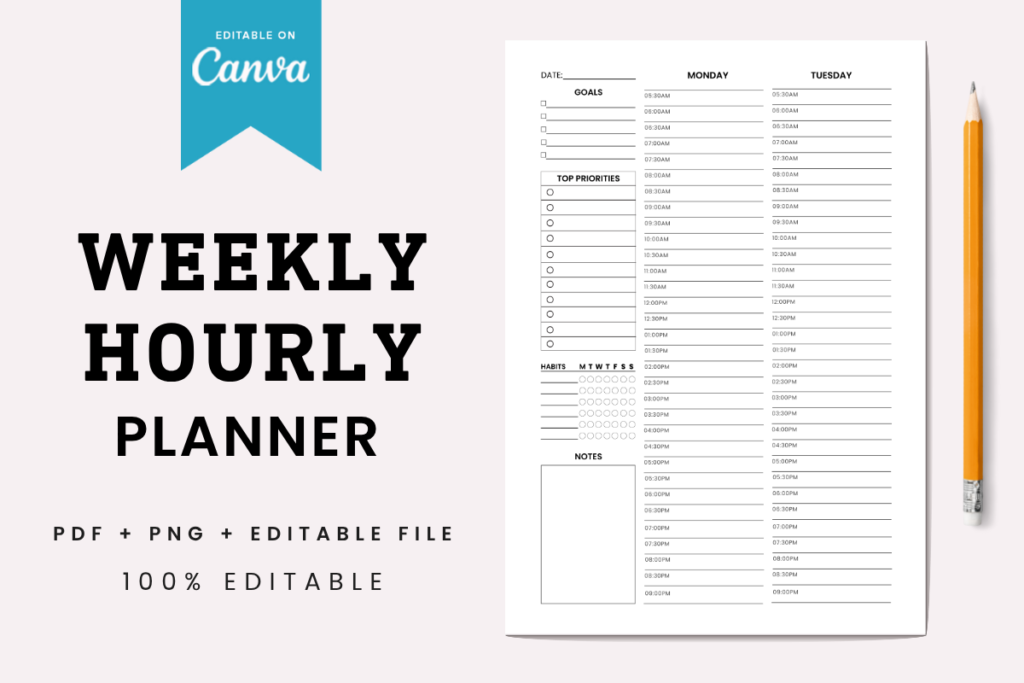
Format: PDF, PNG + Canva template
Pages: 3
Size: A4
Best for: a straightforward weekly hour grid
- Three ready-to-print weekly hourly pages
- Editable text, colors, fonts and layout in Canva
- Works with a free Canva account
It keeps weekly hourly planning simple and easy to repeat. Make a copy in your own Canva account before editing.
Best Two-Page Spread
15. Printable Weekly Hourly Planner Template
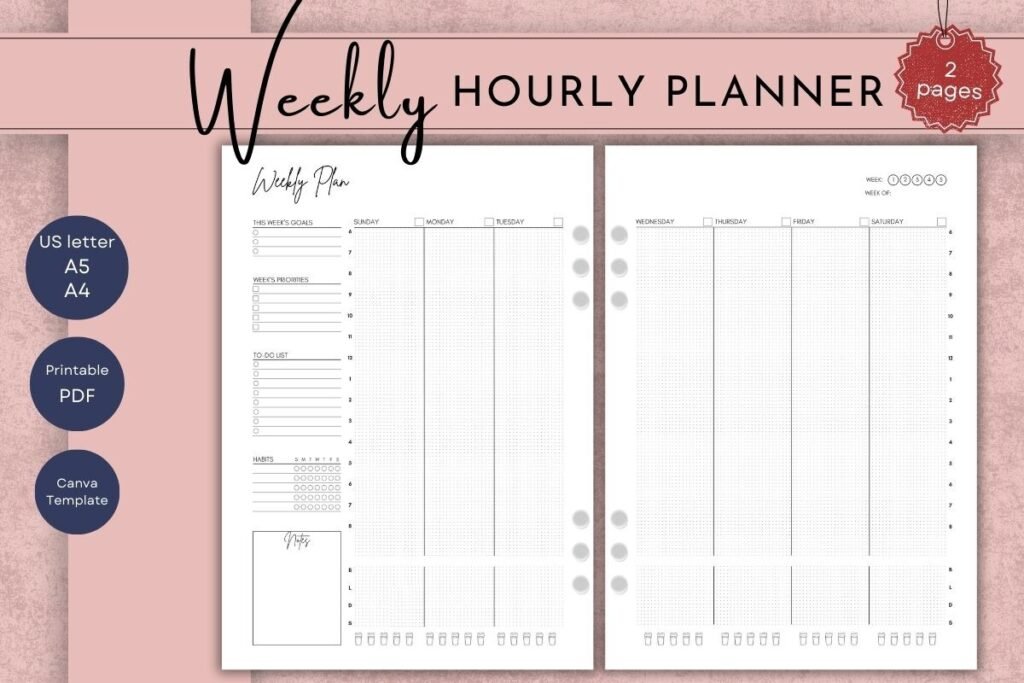
Format: Printable PDF
Pages: 2
Size: A4, A5 and US Letter
Week start: Sunday
Best for: a roomy weekly spread for a binder
- Two-page weekly spread
- Hourly breakdown from 6 AM to 8 PM
- Weekly goals, priorities and habit tracker
A two-page layout gives each day more room than a single sheet. The minimalist design suits any binder.
Hourly Planners at a Glance
| Type | Best for | Key features | Format |
|---|---|---|---|
| Time blocking systems | Building a full routine | Time blocks, focus tools, reviews | PDF, hyperlinked PDF, Excel |
| Daily hourly pages | Busy days | Hour-by-hour grid, to-dos, trackers | PDF, Canva, fillable PDF |
| Weekly hourly pages | Planning the week | Seven days by the hour, priorities | PDF, Canva |
How to Time Block Your Day
- List everything first. Write down tasks, meetings and errands before you open the grid.
- Block fixed commitments. Add meetings, classes and appointments to their time slots.
- Protect one focus block. Reserve 60 to 90 minutes for your most important task.
- Group small tasks. Put emails, calls and errands together in one block.
- Leave buffer time. Keep 15 to 30 minutes free between blocks for overruns.
- Review at night. Compare the plan with what happened and adjust tomorrow’s blocks.
FAQ
What is time blocking?
Time blocking is a planning method where you assign each task or type of work to a specific block of time on your calendar. Instead of a long to-do list, you decide in advance when each task will happen.
Is time blocking good for ADHD?
Many people with ADHD find that time blocks make the day more concrete and reduce decision fatigue. Shorter blocks, buffer time and visual planners often work better than long, rigid schedules.
What is the difference between an hourly planner and a daily planner?
A daily planner usually has a to-do list and notes, while an hourly planner adds a schedule split into hours or half hours. Hourly planners suit days full of meetings, classes or appointments.
How long should a time block be?
Most time blocks last between 30 and 90 minutes. Deep work often needs 60 to 90 minutes, while small admin tasks can be grouped into a 30-minute block.
What is the Pomodoro technique?
The Pomodoro technique splits work into focused 25-minute intervals with short breaks in between. It fits well inside a longer time block when a task feels hard to start.
Final Thoughts
The best hourly planners make your time visible, so you can see where each hour goes before the day starts. Begin with one daily or weekly grid, protect a focus block and review your plan each evening. For background on the method, see this article on timeboxing.


One Comment