

Savings Planners: 11 Best Trackers and Challenges to Save More in 2027
Savings planners make saving money visible, which is often the push you need to keep going. This list includes a no-spend challenge planner, savings goal trackers, ready-made Google Sheets and Excel budgets, 30-day and big-goal savings challenges, a debt payoff bundle with savings pages and a simple digital savings planner. Most are undated, so you can start in any month, not only in January.
Quick Picks
- Best no-spend planner: No-Spend Challenge Planner | Printable B
- Best spreadsheet dashboard: Monthly Budget Savings Tracker Template
- Best for savings goals: Monthly Undated Savings Goal Tracker
- Best short challenge: 30 Day Savings Challenge – Cozy Pastel
- Best for debt and savings: Debt Payoff Tracker Bundle – 3 Color
Savings Planners and Goal Trackers
These planners help you set a savings goal and follow it month by month.
Best No-Spend Planner
1. No-Spend Challenge Planner | Printable B

Format: Printable PDF
Pages: 61
Size: A4
Best for: anyone who wants to spend less and save the difference
- 30-day, 60-day and 90-day challenge trackers and a yearly no-spend calendar
- Personal no-spend rules, a vision and motivation worksheet and spending trigger analysis
- Savings goal planner, savings thermometer, savings jar and milestone trackers
- Daily no-spend trackers and weekly and monthly review pages
The spending trigger pages help you understand why you buy, not just what you buy. Print the pages you need as often as you like.
Best for Savings Goals
2. Monthly Undated Savings Goal Tracker

Format: Canva template
Size: 8.5 x 11 in
Dates: Undated
Best for: following one savings goal month by month
- Cover, index and 12 monthly tracking pages
- Columns for target, saved, remaining and status
- Weekly progress section
Seeing the remaining amount shrink each month is a strong motivator. Because it is undated, you can reuse it year after year.
Best for Debt and Savings
3. Debt Payoff Tracker Bundle – 3 Color
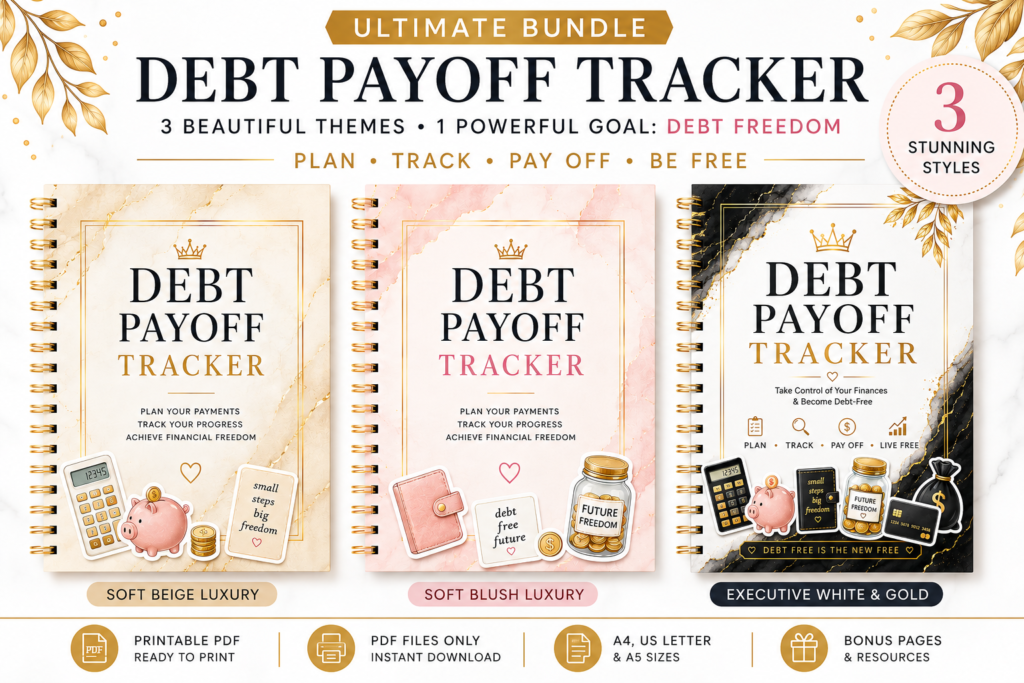
Format: Printable PDF
Versions: 3 color themes
Best for: paying off debt while building savings
- Debt snowball and avalanche worksheets and payoff trackers
- Emergency fund tracker and sinking funds tracker
- 52-week savings challenge and no-spend challenge
- Net worth tracker and annual financial review
Paying off debt and saving often go together, and this bundle covers both in one system. Choose from soft beige, soft blush or white and gold designs.
Best Year at a Glance
4. Yearly Finance Overview – Annual Budget

Format: PDF + digital version
Size: A4 and US Letter
Best for: seeing a whole year of saving on a few pages
- 12-month finance overview and monthly income and expense summary
- Savings tracker and debt reduction log
- Annual bill and subscription overview
- Financial goals progress tracker
A yearly view shows patterns that monthly pages hide, such as which months cost the most. It works printed or in GoodNotes and Notability.
Best Digital Planner
5. Simple Savings Planner, Digital Planner

Format: Hyperlinked PDF (digital use)
Apps: GoodNotes, Notability
Best for: beginners who want a small digital money planner
- Savings challenge tracker
- Purchases tracker
- Bill tracker
Hyperlinked tabs make it quick to jump between pages on a tablet. It is made for digital use rather than printing.
Savings Spreadsheets
Prefer a computer? These savings planners in Google Sheets and Excel do the math for you.
Best Spreadsheet Dashboard
6. Monthly Budget Savings Tracker Template

Format: Google Sheets, Excel, Apple Numbers
Tabs: 5
Best for: people who prefer typing numbers to writing them
- Budget plan and transactions tabs
- Dashboard with net saved, income, spent and savings rate
- All formulas already written, plus sample data to try it out
- Start Here guide that explains every column
The dashboard updates as you type, so you see your savings rate change right away. It opens in Google Sheets, Excel and Apple Numbers.
Best All-in-One Spreadsheet
7. Ultimate Annual and Monthly Budget Light

Format: Google Sheets
Tabs: 20
Best for: tracking savings goals inside a full yearly budget
- Annual financial dashboard and 12 monthly budget dashboards
- Savings goals tracker and sinking funds tracker
- Income, expense and budget versus actual tracking
- Subscription tracker, recurring transactions and an automated smart calendar
Savings goals sit right next to your budget, so you can see how each month’s spending affects them. Custom categories let you match it to your own finances.
Best Simple Spreadsheet
8. Budget Planner Excel Google Sheet

Format: Excel (.xlsx), Google Sheets
Best for: beginners starting with a spreadsheet budget
- Monthly budget tracker
- Income and expense tracking
- Savings overview
A clean, simple layout makes it a good first spreadsheet budget. Reuse it every month on a computer, tablet or phone.
Savings Challenges
Challenges turn saving into a game with a clear finish line, and they work well next to savings planners.
Best Short Challenge
9. 30 Day Savings Challenge – Cozy Pastel

Format: Printable PDF + digital PDF
Size: A4 landscape
Dates: Undated
Best for: trying a savings challenge for the first time
- Undated 30-day savings challenge
- Cute, simple pastel design
- Digital version for GoodNotes, Notability, Noteshelf, Xodo and Samsung Notes
Thirty days is short enough to finish and long enough to build a new habit. Print it for the fridge or fill it in on your tablet.
Best Big Goal Challenge
10. Savings Challenge No Spend Challenge PDF

Format: PDF, PNG, JPEG
Size: A4, A5 and US Letter
Best for: saving toward one big number
- 5000 savings challenge with boxes to color in
- No spend challenge for cutting extra purchases
- Safe margins for binders
Coloring in a box each time you save makes progress visible and fun. Use the pages printed or in digital format.
Best One-Page Challenge
11. Printable Savings Challenge

Format: PDF, PNG + Canva template
Pages: 1
Size: A4
Best for: a quick savings challenge to pin on the wall
- Ready-to-print PDF and PNG
- Editable text, colors, fonts and layout in Canva
- Works with a free Canva account
Change the amounts in Canva to fit your own goal before you print. Make a copy in your own account to keep the original link working.
Savings Planners at a Glance
| Type | Best for | Key features | Format |
|---|---|---|---|
| Planners and trackers | Following a goal | Goals, progress, no-spend rules, reviews | Printable PDF, Canva, digital PDF |
| Spreadsheets | Automatic math | Dashboards, savings rate, sinking funds | Google Sheets, Excel |
| Challenges | Building the habit | 30-day, no-spend and big-goal charts | Printable PDF, Canva |
How to Start Saving Money
- Pick one clear goal. An emergency fund, a trip or a new laptop, with an amount and a date.
- Track spending for a month. You cannot cut what you have not noticed yet.
- Pay yourself first. Move money to savings on payday, before you spend.
- Try a challenge. A 30-day no-spend or savings challenge builds momentum fast.
- Use sinking funds. Save a little each month for yearly costs like gifts and insurance.
- Review monthly. Celebrate progress and adjust the goal if life changes.
FAQ
What is a no-spend challenge?
A no-spend challenge is a set period, often 30 days, when you only pay for essentials such as rent, bills and groceries. The money you would have spent on extras goes into savings instead.
What is the 52-week savings challenge?
In the 52-week savings challenge you save a growing amount each week, for example 1 in week one, 2 in week two and so on. By the end of the year, the small amounts add up to a noticeable sum.
What are sinking funds?
Sinking funds are small savings pots for expenses you know are coming, like holidays, car repairs or yearly subscriptions. Saving a little for each one every month prevents big surprise bills.
How much of my income should I save?
A common guideline is to save around 20 percent of take-home pay, but any regular amount is a good start. Begin with what you can manage and increase it as your budget allows.
When should I talk to a financial professional?
A planner helps you organize your money, but it is not financial advice. If you are dealing with serious debt, unsure how to invest or planning for retirement, consider speaking with a qualified financial adviser or a nonprofit credit counselor.
Final Thoughts
The best savings planners keep your goal in front of you and make every small step count. Start with one goal and one tracker, add a challenge to build momentum and review your progress every month. For background on why saving matters, see this article on saving.


3 Comments